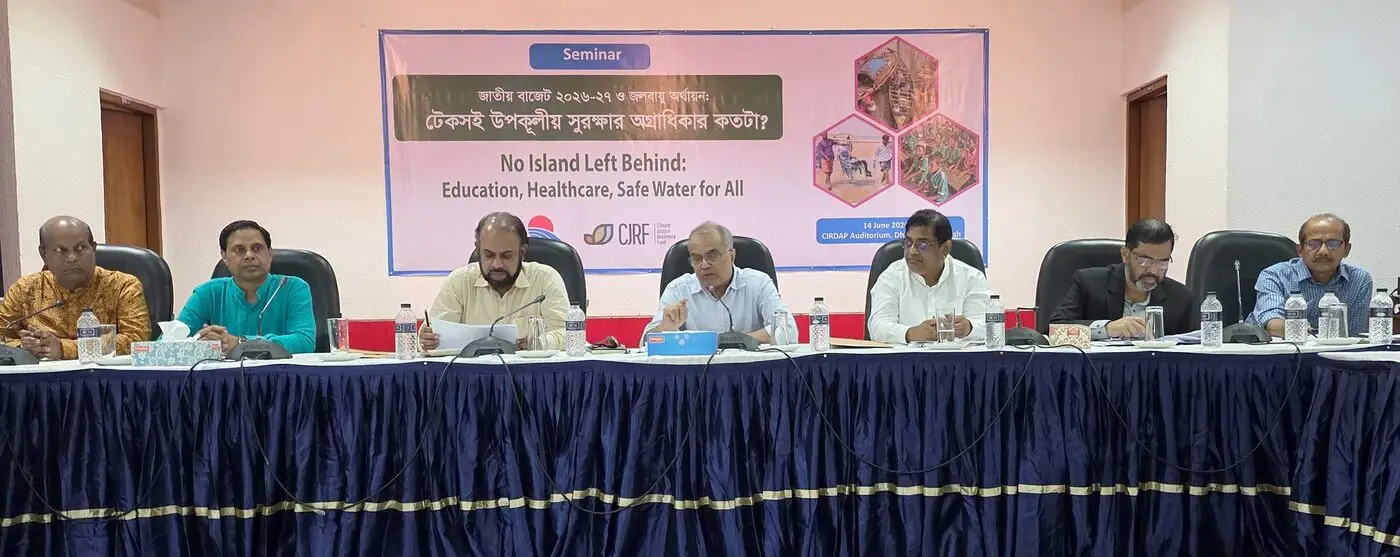
Dhaka, 14 June 2026: Climate activists and speakers have said that the proposed climate budget for FY 2026–27 does not reflect the funding required to implement long-term climate adaptation plans. They noted that, despite steady GDP growth, climate allocations have not increased proportionately, continuing a business-as-usual approach. In the current budget, climate spending stands at only 0.76% of GDP, which they described as far below implementation needs. They urged that climate finance be treated as a strategic national priority, with allocation raised to at least 3% of GDP to protect vulnerable communities.
Speakers demanded a separate adaptation plan for coastal water management, stating that two key areas must be prioritized. First, infrastructure development for coastal protection, including the construction and modernization of embankments, sluice gates, drainage systems, and other water infrastructure, as well as the renovation of old polders and embankments and the development of climate-resilient coastal protection structures. Second, improvement of safe water supply and irrigation systems through rainwater harvesting via pond excavation, restoration of open water bodies and canals, expansion of water-saving irrigation technologies, and development of salinity-tolerant agriculture. They also urge for stringent rules in respect of commissioning deep tube wells to save underground water, especially in Coxsbazar and in Rohingya refugee camps. There should immediately embargo on installing deep tube wells in Rohingya camp, Naf river water should be treated to supply drinking water in the Rohingya refugee camps.
Rezaul Karim Chowdhury, Executive Director of COAST Foundation, stressed that climate justice for coastal communities must be reflected in the national budget. He highlighted salinity, river erosion, water scarcity, and climate-induced displacement as key challenges affecting livelihoods. He called for transparent climate financing focused on vulnerable groups.
Mr. Md. Ziaul Haque, Additional Director General of the Department of Environment, identified two key priorities: protection from water-related disasters and waterborne diseases, and ensuring adequate, safe water for drinking and agriculture. To address the severe drinking water crisis, he emphasized seawater desalination, pond excavation, and rainwater harvesting and storage. He strongly stated that these measures must be learned, adopted, and implemented safely and at scale.